
Industries
Laboratory security in Burlingame
Laboratory security for Burlingame buildings that put lab suites and offices under one roof: one front desk that follows each tenant’s visitor rules, badge checks in the lobby, couriers logged at receiving and after-hours rounds of the doors.
Request a quoteCall (650) 376-8218
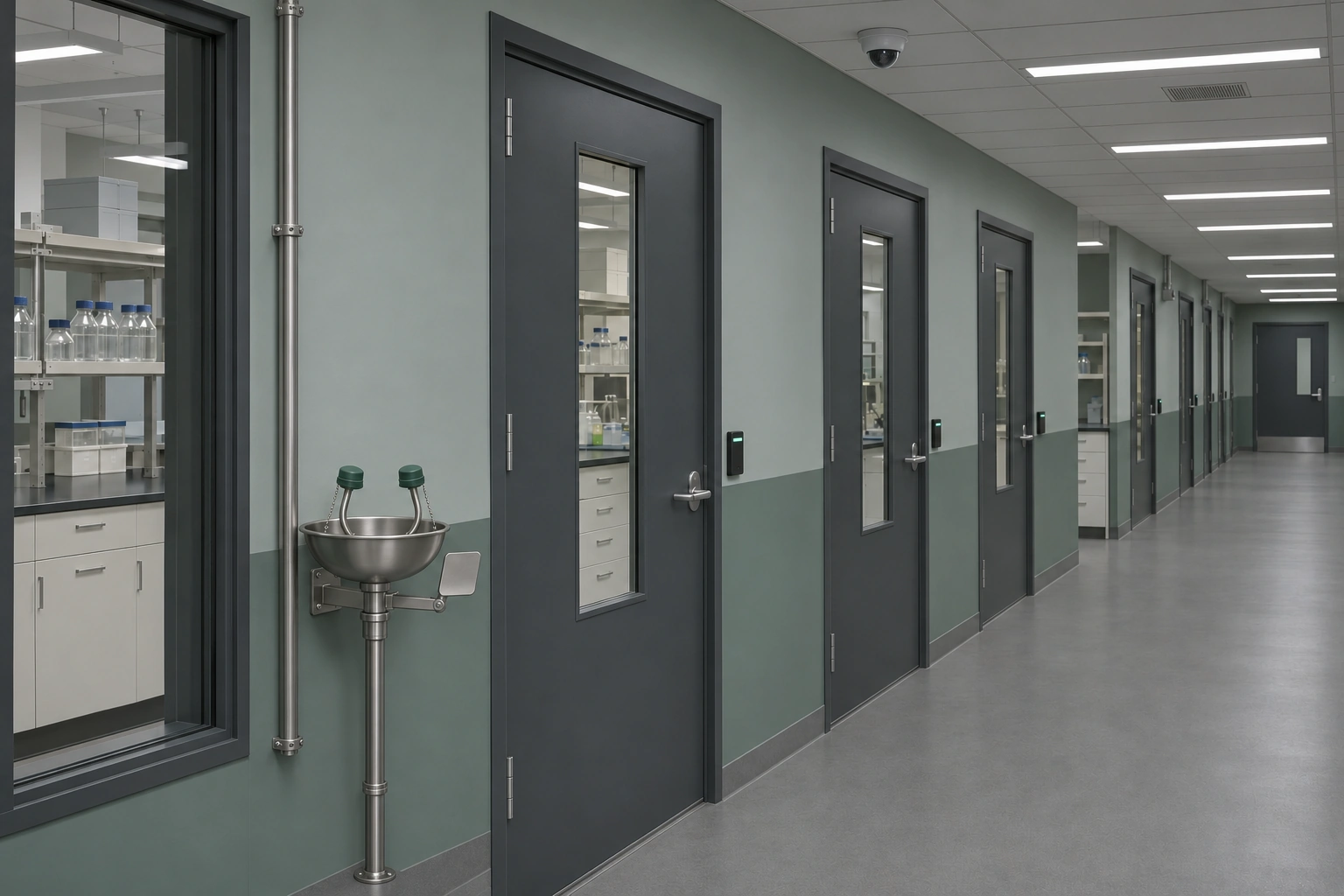
Lab-and-office buildings: one lobby, two kinds of tenant
Laboratory security in a lab-and-office building starts at the front desk. The lobby officer checks badges, signs in visitors and watches the doors, so office tenants get a welcoming entrance and lab tenants get an entrance that knows who belongs. Restricted lab space stays under the lab’s own procedures.
These buildings mix people with very different reasons to be there: office staff and their guests, scientists, couriers with samples and supplies, cleaning and maintenance crews. One lobby routine that treats each group correctly is the heart of the post. We write it into the post orders after a walkthrough with the property manager and each lab tenant’s facility contact.
Badge checks at the lobby and the lab floors
CDC and NIH guidance in Biosafety in Microbiological and Biomedical Laboratories (BMBL) recommends limiting access to authorized, designated employees based on need, with methods as simple as locked doors or a card key system. In a shared building, the officer is the person in front of that system: watching the turnstiles or badge doors, helping a tenant whose badge fails and stopping anyone who walks in behind someone else.
Tailgating in a busy lobby rarely looks like a break-in. It looks like courtesy, someone holding a door for the person behind them. The officer answers in kind, with a friendly request to badge in and a call to the tenant contact when the person has no badge. Door problems, such as a reader that lets a door stand open, go into the shift report with a photo.
Visitor sign-in that works for every tenant
BMBL recommends policies for personnel and visitor identification, visitor management, access procedures and reporting security incidents. It names visitors, lab workers, managers, students, cleaning and maintenance staff and emergency responders as groups to plan access for. At the front desk, that becomes a sign-in routine: the officer confirms the visit with the host tenant, checks the visitor against the expected list, issues a temporary badge under the building’s rules and signs the visitor out again.
Office guests go straight up once their host confirms. Lab visitors wait in the lobby until their host collects them, and officers escort visitors only through non-regulated areas such as the lobby, corridors and shared amenities, handing them over at the lab suite door. The badge count at the end of each shift shows whether every temporary badge came back. Our front desk security page covers the lobby post in more detail.
Couriers, deliveries and the loading dock
Samples, supplies and equipment arrive all day. The receiving officer checks each delivery against the expected list, logs the carrier, the time and the recipient, and calls the lab’s contact for anything marked temperature-sensitive or not on the list. Couriers wait at receiving while the lab sends someone down, and the dock door stays closed between deliveries.
BMBL lists the unauthorized transfer of assets into or out of a facility among the security breaches to report and investigate. A clean dock log and a written incident report give the lab’s own reporting chain what it needs to follow up.
After hours: door checks and the freezer-alarm routine
When tenants leave, coverage shifts to rounds. A posted officer or patrol visits at randomized times check the exterior doors, the dock, the stairwell doors and the corridor doors to each lab suite, confirming they are locked without going inside. Lights, propped doors and anyone in the building after hours go into the timed log.
Freezer and equipment alarms need a routine the lab writes and the officer follows: which panel to check, who on the lab’s call list to phone and in what order, and what stays untouched. The officer’s role ends at the lab door; the lab’s own staff decide what happens inside. Alarm response covers building alarms between rounds, and camera monitoring can watch the dock and entrances overnight.
How CDC and NIH guidance frames lab security
BMBL’s 6th edition, revised June 2020, is published on CDC’s BMBL page. It defines laboratory biosecurity as measures against the loss, theft or deliberate misuse of biological materials, technology or research-related information, and its recommendations are advisory: outside the select agent rules and two executive orders, no federal requirement exists for a lab biosecurity program.
The guidance asks for a site-specific risk assessment, with protections in proportion to the risk rather than against every conceivable threat. It says the people responsible for a facility’s overall security are critical to the program, noting that a facility’s existing security program can already hold many of the measures a lab needs. That is where a lobby post and the building’s own security plan meet the lab’s planning. BMBL also recommends practice drills on incident reporting and responding to security breaches, which can run alongside fire or evacuation drills.
Emergencies and your EH&S team
BMBL says emergency plans should let responders in, and that preserving life and health comes before biosecurity and biosafety in an emergency. Plans should be coordinated with medical, fire and police officials and should consider bomb threats, natural disasters, severe weather and power outages. For the officer, that becomes a short written role set with your EH&S team: meeting fire crews at the entrance, guiding responders to the right floor and keeping the lobby clear, while lab staff lead inside their suites.
Federal security rules for labs
Labs registered under the federal select agent rule (42 CFR 73.11) must write and run their own security plans, built from a site-specific risk assessment. Labs that hold controlled substances follow DEA’s own storage, security and reporting rules (21 CFR 1301.71 and the sections after it). Each lab owns that plan, from drafting it to carrying it out.
Share the parts of your plan that cover the lobby, the dock and the building doors, and we write them into the officer’s post orders.
Start with a walkthrough of the building
We’ll walk the lobby, the dock and the after-hours route with your property manager and lab contacts, then quote in writing a lobby post, overnight patrol, camera monitoring or a mix of them. Contracts run month to month, and every officer is background-checked before the first shift. For buildings with server rooms on site, our data center page shows how equipment spaces are handled, and our office building page covers the office side. Request a quote to book a time.
Common questions
How do lab visitors reach their host?
The officer confirms the visit with the host tenant and signs the visitor in, then either hands them to their host in the lobby or walks them through the shared corridors to the lab suite door.
How does sign-in work when office and lab tenants share the lobby?
Each tenant gives the desk its own visitor rules. Office guests are confirmed and sent up; lab visitors wait until their host collects them. Every visitor gets a temporary badge and signs out on the way out.
What happens when a courier shows up after the lab has closed?
The officer follows the lab’s after-hours instructions: hold the package at the desk, call the on-call contact or ask the courier to return. Each delivery and decision goes into the log with the time.
Who decides how a freezer alarm is handled overnight?
Your lab does. The lab writes the routine, including the call list and what the officer checks, and the officer follows it step by step and records each call.
Can one plan cover a daytime lobby officer and overnight patrol?
Yes. A lobby post through business hours and randomized patrol visits overnight is a common pairing for lab-and-office buildings, with one set of reports for the property manager and copies to lab contacts.